The Drama of Discipleship
Christian Leadership and the Drama of Discipleship
A drama unfolds at the heart of Mark's Gospel. It begins with the beheading of John. It weaves its way through a narrative arc and comes to a stunning climax with the words of Christ:
“You know that those who are considered rulers of the Gentiles lord it over them, and their great ones exercise authority over them. But it shall not be so among you. But whoever would be great among you must be your servant, and whoever would be first among you must be slave of all. For even the Son of Man came not to be served but to serve, and to give his life as a ransom for many.” (Mark 10:42-45)
Perhaps these words are familiar to you? If so, I encourage you to read them again.
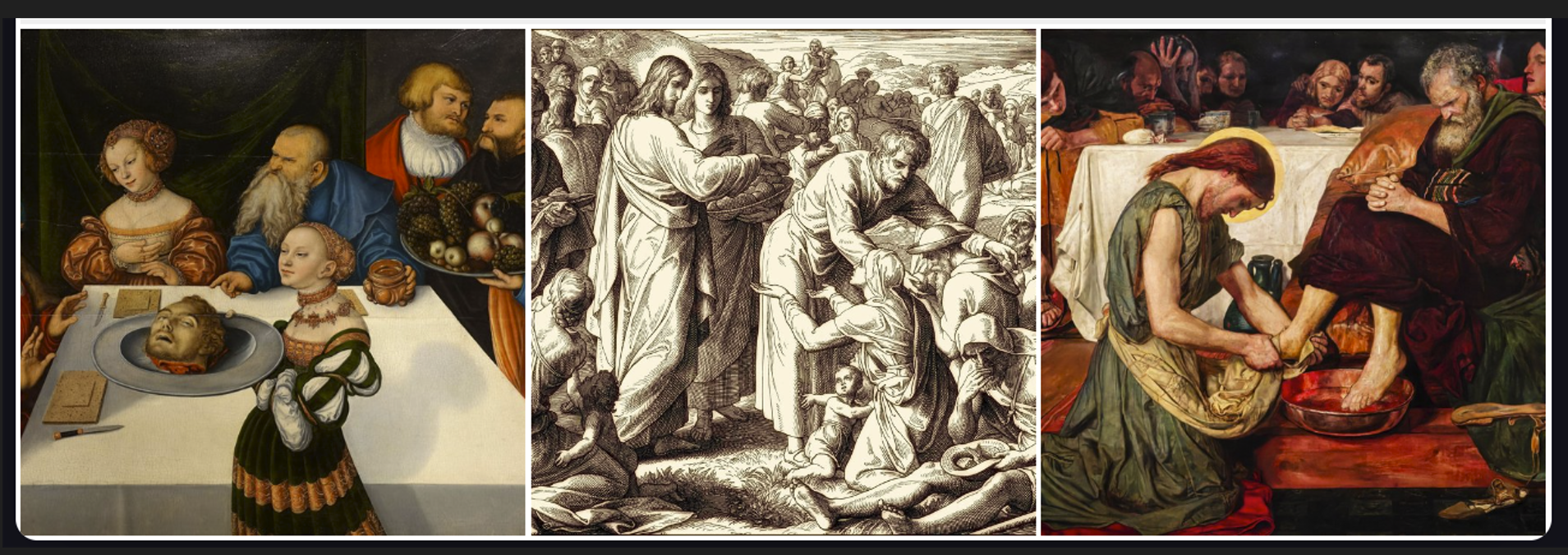
This time, as you read, let that scene from the feast of Herod echo in the background as a point of contrast. Draw a line in your mind. To the left, at the far end, set a placeholder for the feast of Herod. Can you see it? Now, move along the line to the right. Keep moving. The line stretches out before you and begins to flow into a very different reality. At the the other end of the line, set a placeholder for Christ and the way of the cross.
Christ's message of sacrificial service and the gruesome, self-serving scene at Herod’s feast stand worlds apart – a contrast of character for the ages.
I live in the space between these two realities. Leaning into the beauty of Christ on one hand, lured by the leaven of Herod on the other. This is the gap – the contested space – where Christ-like character is progressively formed, or, alternatively, surrendered. No one remains stationary on this line. Life and leadership are too dynamic for that. We are ever in motion, moving toward or away from the way of the Cross – the way of Christ.
This is the gap – the contested space – where Christ-like character is progressively formed, or, alternatively, surrendered.
Let me offer a framework for our thinking by tracing three scenes that capture the contours of this drama. Bear with me! Like I said, I'm building a case.
Scene One: The Feast of Herod
Scene Two: Christ's Mysterious Word of Warning
Scene Three: The Lesson of the Cross
Scene One: The Feast of Herod
*Mark 6:14-29 – See text below
The feast of Herod sets the stage.
Three things about Mark’s account of the story stand out: its length, it's focus, and it's descriptive detail. Each one sends a strong signal: stop! Pay attention! There's something here you need to see.
Of the four Gospels, Mark’s is by far the shortest. Mark is famous for his brevity. Everything is compressed, a kind of minimalist approach to the Gospel. Yet, oddly, Mark’s account of Herod's Feast is by far the longest. Why?
Mark’s gospel, known for its relentless and fast paced action, moves from scene to scene in rapid succession. But here, with the feast of Herod, the pace suddenly slows. The story stretches out before us. We're invited to linger over this scene, enter the dining hall, find a seat at the table, take it all in, along with all the distressing details. There’s something important for us to see, and it’s more than the beheading of John.
Which brings us to the issue of focus.
Many readers of Mark’s Gospel would title this scene: "The Execution of John the Baptist." Instead, I have labeled it: "The Feast of Herod." It’s an important distinction. If the primary focus of the story is the execution of John, it becomes an example of the cost of true discipleship, the kind of brutal opposition that Christians have and will encounter. But then why include the elaborate depiction of Herod and his feast? Given Mark’s preference for brevity, why not dispense with the descriptive detail, explain that John was executed by Herod, and get on with story of Jesus? In my reading of Mark’s Gospel, this story is not primarily about John, but rather, Herod himself.
Even more remarkably, this is the ONLY story in Mark’s Gospel that focuses on someone other than Jesus. From the opening sentence in the first chapter, Mark has signaled his focus:
“The beginning of the Gospel of Jesus Christ the Son of God.” (Mark 1:1).
This headline is followed by a flurry of images that race by in rapid succession, each one focusing on Jesus. But here is the exception. This story focuses on Herod and his feast. This story is meant to stand out. Why?
Finally, Mark breaks his stylistic pattern again, by giving us the kind of detailed description largely missing from the rest of his Gospel. Here, he illuminates details of Herod’s inner life: motives, emotions, thoughts. This is unusual for Mark. He doesn’t normally pause to explore the “inner states” that drive people’s behavior. But in this story we find the opposite. Suddenly, we find ourselves peering directly into Herod’s heart: fears, motives, vacillating thoughts, concern over his public image. Why?
Along with that, Mark lays out the dynamics of the feast itself.
What’s the reason the feast? Herod is honoring himself by hosting his own birthday party. What does the guest list look like? It's a who’s-who of cultural elites, an impressive gathering of “influencers” of the ancient world, each one has their hand on a lever of power, each one possesses a “platform” from which they can sway the larger public. They have come on a quest, to gain, maintain, or increase status – power by proximity.
Cranach captures the horror of this scene in his vivid painting. A severed head paraded before a roomful of party guests is the visual. But Herod's heart, and the actions that flow from it, become the literary focus of Mark's story.
There's an unfolding drama at the center of Mark's Gospel. The Feast of Herod is scene one. The lure of power is the theme.
But wait!
I can already hear the pushback! Is power always bad? Isn't there a legitimate form and use of power? And by the way, you haven't even defined "power," so what exactly are you talking about? And since when did Herod become part of a paradigm on Christian leadership?
Right. Looks like we have much to explore in coming posts.
In posts to come, we will explore Mark's portrait of Herod: his heart, motives, thinking, use of power and how Christian leadership may begin to reflect the way of Herod rather than the way of Christ.
But first, there's a reason Mark has given us this complex and dramatic picture. That leads us to our next post.
Next Post: Christ's Mysterious Word of Warning
Previous Post: The Crisis of Christian Leadership
*The Feast of Herod – Mark 6:14-29
King Herod heard of it, for Jesus’ name had become known. Some said, “John the Baptist has been raised from the dead. That is why these miraculous powers are at work in him.” But others said, “He is Elijah.” And others said, “He is a prophet, like one of the prophets of old.” But when Herod heard of it, he said, “John, whom I beheaded, has been raised.” For it was Herod who had sent and seized John and bound him in prison for the sake of Herodias, his brother Philip’s wife, because he had married her. For John had been saying to Herod, “It is not lawful for you to have your brother’s wife.” And Herodias had a grudge against him and wanted to put him to death. But she could not, for Herod feared John, knowing that he was a righteous and holy man, and he kept him safe. When he heard him, he was greatly perplexed, and yet he heard him gladly. But an opportunity came when Herod on his birthday gave a banquet for his nobles and military commanders and the leading men of Galilee. For when Herodias’s daughter came in and danced, she pleased Herod and his guests. And the king said to the girl, “Ask me for whatever you wish, and I will give it to you.” And he vowed to her, “Whatever you ask me, I will give you, up to half of my kingdom.” And she went out and said to her mother, “For what should I ask?” And she said, “The head of John the Baptist.” And she came in immediately with haste to the king and asked, saying, “I want you to give me at once the head of John the Baptist on a platter.” And the king was exceedingly sorry, but because of his oaths and his guests he did not want to break his word to her. And immediately the king sent an executioner with orders to bring John’s head. He went and beheaded him in the prison and brought his head on a platter and gave it to the girl, and the girl gave it to her mother. When his disciples heard of it, they came and took his body and laid it in a tomb.
Mark 10:42-45
“You know that those who are considered rulers of the Gentiles lord it over them, and their great ones exercise authority over them. But it shall not be so among you. But whoever would be great among you must be your servant, and whoever would be first among you must be slave of all. For even the Son of Man came not to be served but to serve, and to give his life as a ransom for many.” (Mark 10:42-45)