Christ's Compassion for the Hurting and the Beauty of Our Calling
Christ’s Compassion for the Hurting and the Beauty of our Calling
I was going to jump straight into scene two in the unfolding drama: “Christ's Mysterious Word of Warning.”
But I'm putting that on hold. Let's pause, think past Herod’s awful feast, and explore Christ's compassion and the beauty of our calling.
We need this. This is the context that will make sense of Christ's warning about the leaven of Herod.
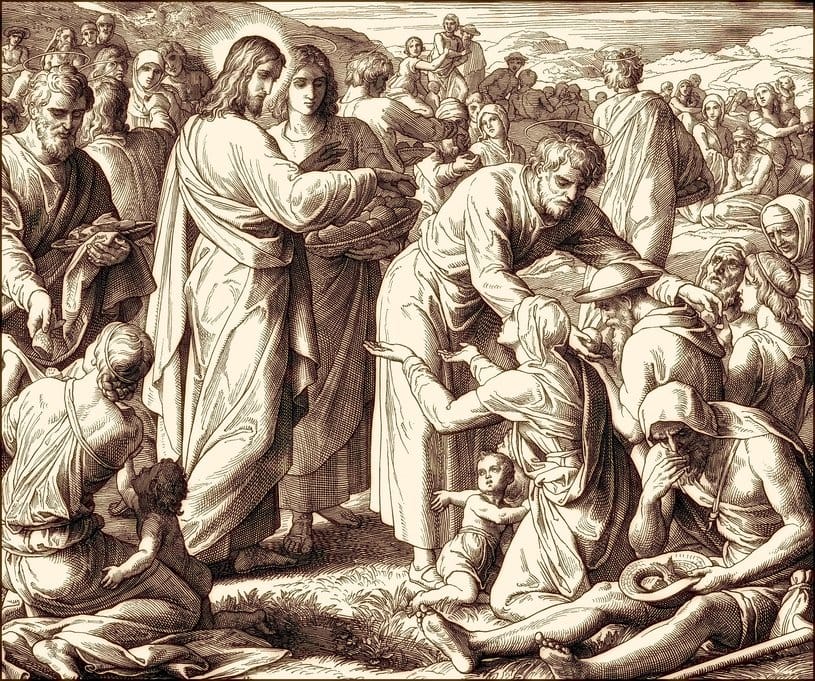
Mark 8:1-10 sets out the story of the miracle of the loaves and fishes.
Mark 8:1–10 (ESV)
1 In those days, when again a great crowd had gathered, and they had nothing to eat, he called his disciples to him and said to them, 2 “I have compassion on the crowd, because they have been with me now three days and have nothing to eat. 3 And if I send them away hungry to their homes, they will faint on the way. And some of them have come from far away.” 4 And his disciples answered him, “How can one feed these people with bread here in this desolate place?” 5 And he asked them, “How many loaves do you have?” They said, “Seven.” 6 And he directed the crowd to sit down on the ground. And he took the seven loaves, and having given thanks, he broke them and gave them to his disciples to set before the people; and they set them before the crowd. 7 And they had a few small fish. And having blessed them, he said that these also should be set before them. 8 And they ate and were satisfied. And they took up the broken pieces left over, seven baskets full. 9 And there were about four thousand people. And he sent them away. 10 And immediately he got into the boat with his disciples and went to the district of Dalmanutha.
In this story, Mark gives us a dazzling account of Christ’s compassion and the beauty of our calling.
The Beauty of Our Calling
With the feeding of the multitude the disciple's enthusiasm for ministry comes to a crescendo. This is the fulfillment of everything they hoped for when they first answered Christ's call.
The opening chapter of Mark's Gospel describes the call and their response.
Mark 1:16–20
16 Passing alongside the Sea of Galilee, he saw Simon and Andrew the brother of Simon casting a net into the sea, for they were fishermen. 17 And Jesus said to them, “Follow me, and I will make you become fishers of men.” 18 And immediately they left their nets and followed him. 19 And going on a little farther, he saw James the son of Zebedee and John his brother, who were in their boat mending the nets. 20 And immediately he called them, and they left their father Zebedee in the boat with the hired servants and followed him.
They took a risk. Walking away from what they knew best, they followed Jesus into an unknown future. Countless Christian leaders can relate to this experience. It's the excitement and adventure of launching into a life of Christian ministry. This is my story too.
Christ’s promise filled their hearts, fired their imaginations, and set their feet in motion. They left everything to take part in something amazing, something beautiful, something that would impact others for good. Like Jesus, they would become fishers of men and women in a hurting world.
The days that followed didn’t disappoint. Moving forward, the story describes an avalanche of extraordinary experiences. The disciples had a front row seat for all of it: both miracles and mercy. More than mere bystanders gawking at greatness, they were appointed to participate in the work of ministry.
Then, in Mark 8, we come to the feeding of the multitude, and the disciples come to their ministry high point, participating in the miracle, playing a part in this extraordinary moment. What a thrill!
This is the beauty of our calling. Those in Christian leadership are held captive by the privilege and significance of joining Jesus in his mission to our hurting world.
Christ’s Compassion for the Hurting
Read the story again. Watch for the first words.
Jesus' first word: compassion.
“I have compassion on the crowd, because they have been with me now three days and have nothing to eat. 3 And if I send them away hungry to their homes, they will faint on the way. And some of them have come from far away.” (Mark 8:2-3)
Christ’s compassion leads the way. Compassion is how Jesus frames this moment for his disciples. It’s more than a demonstration of miraculous power. It is that, but more than that. This is a mentoring moment for the disciples – a lesson that goes to the heart of Christian leadership. The keyword is compassion.
But what is compassion?
The Greek word used in the text sounds odd to my ears: “Splanknidzomai.”
Sounds harsh – like a spanking – hard edged! Maybe that’s because the word points to the feeling in your gut when your emotions are touched. It’s your heart, or your spleen, or your intestines, or something like that. So, here’s what it describes: a gut punch – splanknizomai! – POW!
Jesus saw the hurting, hungry crowd, and pow! It was an emotional gut punch for him – compassion.
Jesus wants his disciples to know this. He wants them to feel it. He wants us to feel it too.
But what is compassion?
Christians make a practice of arguing about words. Almost anything, it seems, can become a pitched battle for a theological or political point of view: even a word like compassion.
In recent years there’s been quite a debate over the idea of compassion. Who would have thought it? The debate revolves around two words related to the theme of compassion: empathy and sympathy. If you missed the debate, count yourself lucky and forgive me for bringing it up!
The argument goes like this: the word empathy is a problem for Christians. It should be avoided. Why? Because empathy means we identify too closely with the hurts of people. In contrast, the word sympathy is preferred because sympathy means we feel “with” or “for” the hurts of people, but it implies a bit more distance. This may seem like a subtle difference, but evidently some Christians are quite worked up about the distinction. Which is why there are sermons and books with titles like: Leadership and the Sin of Empathy. Really? The sin of empathy? The concern is that we might make the mistake of identifying with people or groups who have a “victim” mentality. This might validate some kind of misguided identity politics. Soon we will be on the path of evil ideologies. Things like “Critical Race Theory” might creep into the church. Who knows where this will lead? Shortly, we may find Karl Marx or his representative at the pulpit preaching from the Communist Manifesto rather than the bible.
The word sympathy is safer. That way we don’t need to personally identify with the plight of any particular group or make the error (sin?) of putting ourselves in their shoes. Instead, we should look at them from a bit more distance and feel sympathy – feel sorry for them.
Talk about “straining at a gnat and swallowing a camel!”
Meanwhile Jesus stands before a group of people who are hungry and might faint and he's hit with a gut punch of emotion. He wants to do something about it. He wants his disciples to help.
And, significantly, between the feast of Herod in Mark 6 and the mysterious word of warning about the leaven of Herod in Mark 8, there is not one, but TWO episodes of Jesus feeding a multitude. The first is in Mark 6 immediately after the feast of Herod!
Once again, compassion is the keyword.
34 When he went ashore he saw a great crowd, and he had compassion on them, because they were like sheep without a shepherd. And he began to teach them many things. 35 And when it grew late, his disciples came to him and said, “This is a desolate place, and the hour is now late. 36 Send them away to go into the surrounding countryside and villages and buy themselves something to eat.” (Mark 6:34-36).
No doubt, an intentional contrast is being made. The feast of Herod – brutal. The feast(s) of Jesus – beautiful.
What’s the point?
Compassion is key. Compassion is key to the ministry of Christ and key to Christian leadership.
What about Herod? “Splanknizomai” is nowhere to be found, regardless of how you translate it: empathy, sympathy, or compassion.
Christ’s was moved with compassion for lots of reasons. In one case it’s because people were like sheep without a shepherd. But in Mark 8 it’s simply because people are hungry and might faint!
In the gospels, the miracles of Christ are proof of his power, proof of his claim to be the Son of God, the Messiah. But there is something else. They are windows into his heart for hurting people – a heart of compassion. This is a core quality of Christian leadership. As we will see, the leaven of Herod works to undermine this. So, Jesus issues a warning.
The warning matters because the mission of Christ matters. The warning matters because the heart of Christ matters. The warning matters because the call of Christ matters. There is so much at stake, so much that Christ wants to do in our hurting world through his church. Christian leadership matters. Which is the whole reason for LessHerod.Com.
Next Post: Christ's Mysterious Warning
Previous Post: The Drama of Discipleship